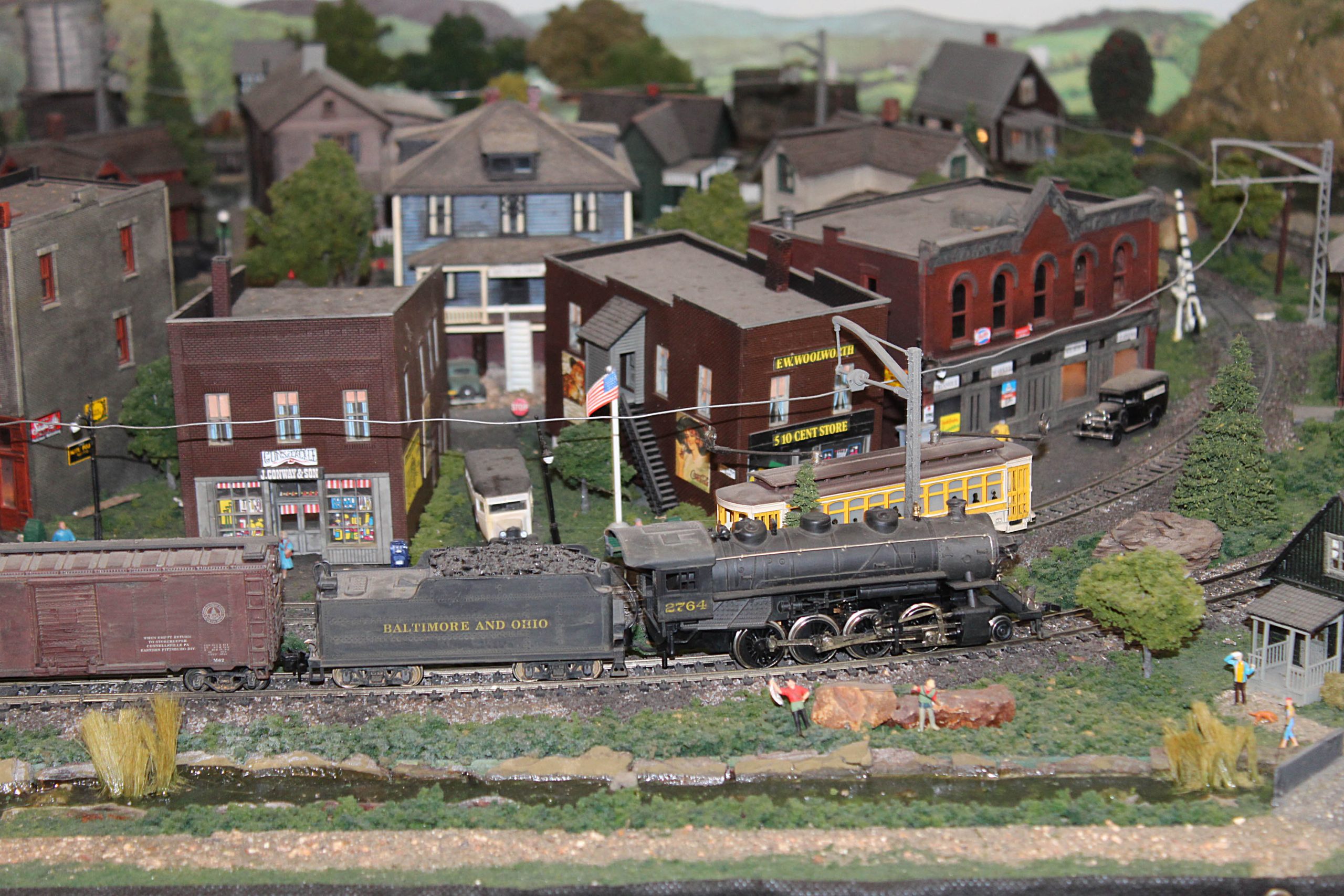
After I wrote about the L&N Railroad, Ed Mesta called me to ask if I’d like to have a look at his model railroad layout. After seeing it, I thought it deserved a story of its own. First, a little background about Ed Mesta.
Dr. Edward H. Mesta was raised in Washington County in Western Pennsylvania. His dad had had a Lionel train layout (O‑gauge) that encircled the Christmas tree every year. He built the engines and cars from kits. The train layout was always set up on Christmas Eve.
In 1967 Ed and his wife Suzanne moved to Winchester, where Ed became pastor of the First Presbyterian Church. He retired after serving in that position for 31 years. He needed something to occupy his time, so he decided to build a model railroad in the basement of their house on Crescent Avenue.
Ed grew up as a modeler himself. He started with cutting out buildings on the back of Cheerios boxes and putting them together. He progressed to building plastic kits of planes, cars and ships. He put those skills to work when he started on his own HO-gauge model railroad. Ed based the layout on his family’s Western Pennsylvania past.
Phase I of the project began with a 4 x 8 sheet of plywood mounted on a bench. He planned the layout to represent Finleyville, site of the Mesta family farm. Laying the track and wiring was the first order of business. Then he marked off streets and began filling them with structures—homes, businesses and outbuildings put together from kits and painted. The final stage was landscaping, which included adding trees, a stream, fences, vehicles, people, and animals along with many other details. While that was going on, he was also building the locomotives and cars for the layout.
For Phase II, Ed added on to the left side of the layout a 4 x 4 plywood sheet representing the Mesta Machine Company in West Homestead. This was the company started by his great-grandfather’s brother, George Mesta, in 1898. The company prospered building huge machines for factories. It was one of the largest of its kind in the world.
Never miss a thing with our FREE weekly newsletter.
I counted 70 plus structures, five locomotives, numerous cars, a streetcar, and countless figures. He purchased kits from model railroad catalogs and Lexington hobby shops. Some structures were scratch built from piece parts. He started work on the layout in 1998 and, remarkably, finished it in only a year and a half. The craftsmanship is amazing—the finished product is the work of a skilled modeler.
After a quarter of a century, the layout remains intact, and the train still runs smoothly around the tracks. Ed would like to find a good home for the layout, but there is one problem: it’s too big to get out of the basement in one piece. He is interested in finding someone with the skills to disassemble the layout and put it back together in another location. It might be a good fit for another model railroader or possibly even a local business that could use it as an attraction to draw customers. Ed asks anyone interested to contact him at esmesta@att.net.
In closing, I should mention that Ed wrote a book about his family that includes descriptions of Finleyville and the Mesta Machine Company: My Mesta Family Story available at Amazon.
Photo gallery
Click anywhere below to enlarge the photos in the gallery.