
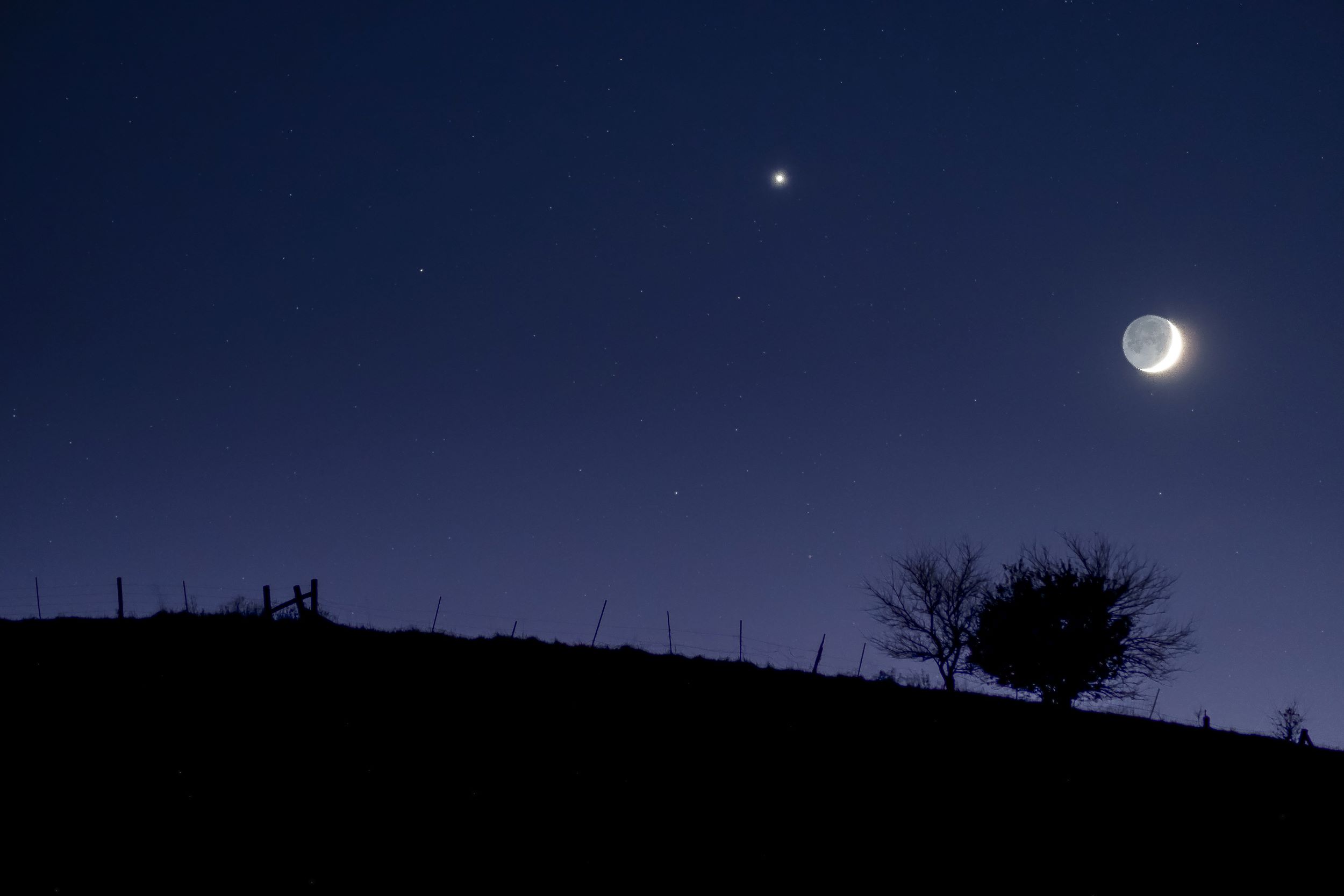
It was 6:30 pm this past Sunday and I had just turned on to our long driveway. Sunset had been an hour ago. In the southwest sky was a sight that caused me to stop the car and stare. Just above the adjacent hill where the cattle were grazing was a beautiful crescent moon, and near it was a bright object that I assumed was a planet. The part of the moon that is usually dark was visible, with a slight glow.
It was mesmerizing.
I had my camera and tripod in my car — and my djembe. The moment called for drumming or taking a photograph, or both. I decided to try to get a quick photo before the scene changed much. I put a longer lens on my camera, set up my tripod along the driveway, attached the camera, and pointed toward the top of the hill. I would have liked to have spent some time choosing between different foregrounds, but these kinds of moments can be fleeting so I used what was given to me right where I stopped the car.
When I got to the house I looked it up and learned that the other bright object was indeed a planet, Venus. Being able to see the usually dark part of the moon was due to a phenomenon called earthshine, when sunlight reflects back to the moon from the Earth itself.
It’s easy to imagine our early ancestors sitting around wondering about the night sky and trying to make sense of it. Heck, contemplating the night sky fills me with wonder and awe too.
