The Boone family left their mark in Clark County before we became a county in 1792. As it turns out, the most famous Boone left his footprints all over the county. For example, Lulbegrud Creek on our eastern border was named by Daniel Boone while camping there in 1770, and Boone Creek on our western border was named for Daniel Boone before 1779.
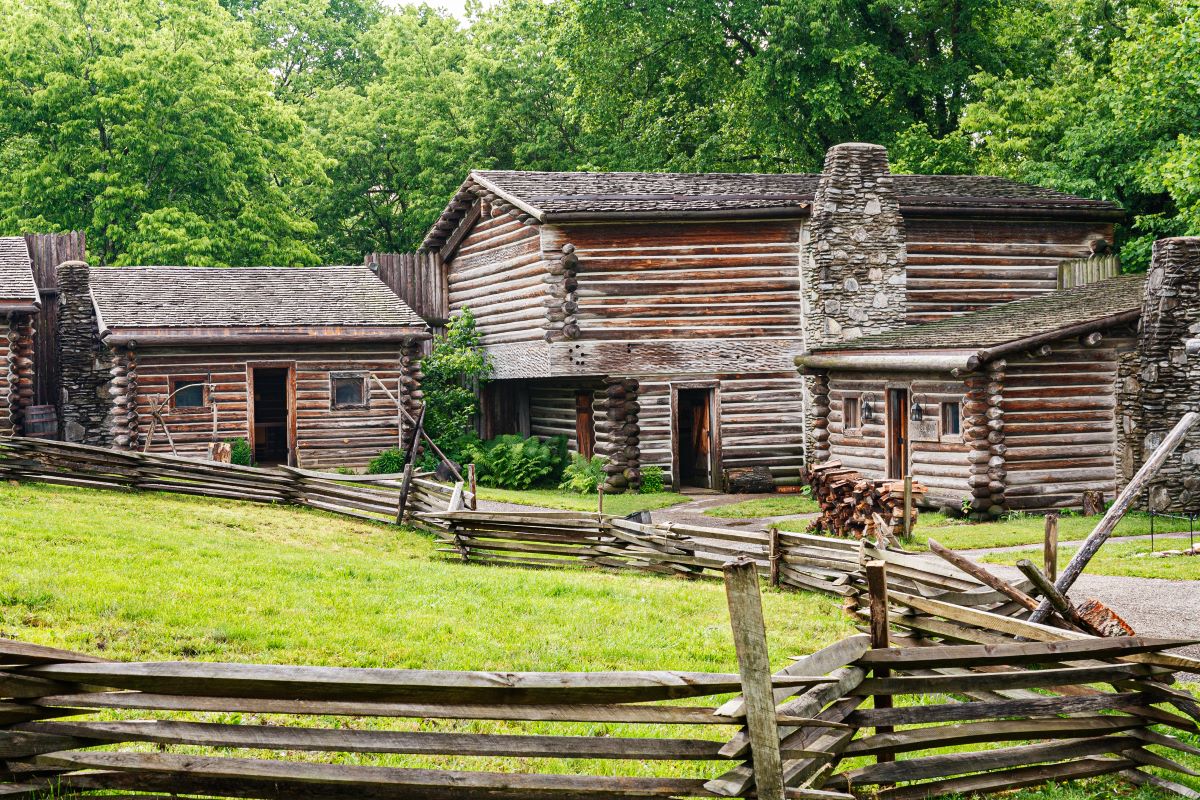
Kentucky’s earliest pioneers were allowed to claim 400 acres for a settlement as well as an adjoining 1,000 acres called a “preemption.” Daniel Boone selected a site on George’s Creek, a branch of Stoner, for his Kentucky settlement and preemption. After surveying his 1,400 acres, Boone decided not to live there and sold the land to William Scholl. William’s sons—Joseph, Peter, and Abraham—erected a small fortress there called Scholl’s Station. The station, located near present-day Schollsville, provided protection for neighborhood residents in the event of an Indian raid.

Daniel’s daughter Levina married Joseph Scholl. She lived and died in the Schollsville neighborhood. According to the Clark County Chronicles, written in the 1920s, Levina and her sister Rebecca Boone Goe are buried in the Scholl Graveyard on the north side of Schollsville Road. This family cemetery has been lost for many years.
Daniel’s brother, Samuel Boone, left children with Clark County connections. In the summer of 1786, several of his offspring joined Providence Baptist Church on Lower Howard’s Creek—sons Squire and Samuel Jr., a daughter Mary who married Leonard K. Bradley, and a daughter Elizabeth who married William White. There is not a shred of evidence to support the notion that Daniel Boone attended church there. Scholarly studies of the church have been prepared by Baptist historians and Clark County historians with no mention of his name, not even so much as an “it has been said....” Furthermore, Boone is known to have shunned organized religion all his life, going back to the time of his father’s ill treatment by the Quakers in Pennsylvania.
Samuel Boone Jr. (1758−1843) left a rich history in the county. He was a Revolutionary War veteran and received a pension for his service while residing here. When he was 78 years old, Samuel wed Susan House. She married with the consent of her father, so Susan must have been under the age of 21. Samuel’s will left all his estate to Susan, then she died only four years after Samuel. Her will left everything to her House nieces and nephews, indicating that she and Samuel had no surviving children.
Samuel Jr.’s brother Thomas was killed and brother Squire badly wounded at the Battle of Blue Licks in 1782. Squire became a licensed Baptist minister in 1790 and pastored Boggs Fork Church in Fayette County. Squire’s son Thomas “Tommy” Boone was a well-known Baptist preacher in Clark County for many years. Ordained in 1815, he pastored Log Lick, Dry Fork (on Upper Howard’s Creek), New Providence (near Kiddville), and Lulbegrud churches. In 1832 Providence Church on Lower Howard’s Creek received permission from New Providence for Reverend Boone to serve them with one-fourth of his time, presumably one Sunday a month.
Rev. Tommy Boone married Sallie Muir, and they raised twelve children. Their son Ira became a Baptist preacher, and daughter Polly married a Baptist preacher, James Edmonson. Sallie was interviewed by Rev. John Shane, to whom she made some amusing comments about Eli Cleveland (yet another pioneer Baptist preacher, for whom Cleveland Road takes its name): “Had a good many adventures. Was shot at several times. Shot once in his bed.”
Rev. Tommy and Sallie are buried in the Lulbegrud Churchyard in Montgomery County. During the Civil War, their son George kept Boone Tavern in Winchester at the southeast corner of Main and Broadway. George had twin sons who chose to fight on opposite sides in the war, epitomizing the maxim “brother against brother.” Tommy and Sally left numerous descendants who will be the subject of a future article.
Never miss a thing with our FREE weekly newsletter.

Daniel’s brother Edward “Ned” Boone was killed by Indians while the pair were out on a hunting trip in 1780. Ned had married Martha Bryan, a sister of Daniel’s wife Rebecca. After Ned’s death, Martha left Boone’s Station near Athens and purchased 100 acres of land on Boone Creek in Clark County. Martha died in 1793, leaving a will that named six children. Four later left Kentucky, while daughter Mary and son George remained in Clark County. Mary married Peter Scholl, who was in the battle of Blue Licks and was a brother of Joseph, mentioned above. The couple lived on the Daniel Boone tract—the 1,400-acre settlement and preemption—surrounding Schollsville and raised fourteen children there.
Ned and Martha’s son George lived on Boone Creek in Clark on land he purchased from Eli Cleveland. George married twice—Patty Hazelrigg in 1793 and Hester Lock in 1801. They had a number of children, but all eventually left the county, many following George and Hester to Daviess County.
It was surprising to find an unrelated Boone in the same area. George G. Boone also lived on Boone Creek. He was raised in King George County, Virginia, a son of William Boone and Keziah Green. George married Mary Plunkett in Clark County in 1835. They were still residing in Clark in 1850. Coincidentally, George G. Boone was also a Baptist minister and served for three years as pastor of Providence Church on Lower Howard’s Creek, 1828–1830. He later moved to Fayette where he was pastor of Boone Creek Baptist Church.
This brief article can only begin to lay out a history of all the Boones who lived here over the last 200-plus years. To do a thorough job of describing the Boone families of Clark County would require a book. It’s one I’d like to work on if I can ever find the time.