
The triumph and tragedy of RFK Jr.
The young woman and I were the last ones in the room with Robert F. Kennedy Jr. following his press conference.
She unfolded a faded newspaper and asked him to autograph the front page. It was an issue with a photograph of Kennedy’s father lying on his back on the floor in the Ambassador Hotel in Los Angeles moments after he had given his victory speech in the 1968 California Democratic presidential primary, concluding: “Now it’s on to Chicago, and let’s win there!”
As the senator was leaving through the kitchen, a Palestinian, who hated Kennedy because of his support for Israel, fired three shots, including one to the head that would end his life, and with it the hopes of a generation of young Americans.
A look of grief came over the younger Bobby’s face as he stared at the picture of his father, then he quietly told the girl he couldn’t.
“Don’t you think that was cruel?” I asked her as she crammed the paper back into her bag.
“No, I don’t!” she said, and stormed off.
That was in April of 2000, and Kennedy, senior attorney for the Natural Resources Defense Council, had come to Eastern Kentucky University to give an Earth Day lecture on “Our Environmental Destiny.”
I had been interested in RFK Jr. since the 1980s, when I wrote a book report for a class at EKU on his biography of U.S. District Judge Frank M. Johnson Jr.

On this day, I was carrying an autographed copy of The Riverkeepers, which Kennedy had co-authored with John Cronin, a commercial fisherman. It was a firsthand account of their fight against corporate and government polluters of the Hudson River in New York.
Within days of meeting RFK Jr., I also met his sister, Rory Kennedy, a documentary filmmaker, at the University of Kentucky’s library. She was surprised to learn that her brother had been nearby.
Four years later, her brother Bobby was featured in her film “Indian Point: Imagining the Unimaginable,” about what would happen if a nuclear energy plant on the Hudson River came under attack by terrorists.
According to an article by Joe Hagan in the current issue of Vanity Fair, Rory had warned her production team about the liability of involving Bobby in the film: that he couldn’t be trusted to tell only the truth, and that he might get them sued.
The crew ended up having to remove interviews in which Bobby had made inaccurate and inflated claims.
“He can say some crazy shit,” Rory said. “That’s who he is.”
Who is RFK Jr.?
Twenty years later, that’s still who RFK Jr. is — only worse.
According to the September 2024 Vanity Fair story, Kennedy’s family members and friends are familiar with his “problematic personality—the outsize confidence masquerading as expertise, the ‘savior complex’ (as one family member called it) that drives him to make up quixotic causes and cast himself as a lone hero against established powers, and, above all, as one old friend calls it, his ‘pathological need for attention.’”
Given their similarities, perhaps it should come as no surprise that a year and a half after Bobby Jr. began his own quest for the presidency, first in the Democratic primaries and then as an independent, he ended his campaign last month and endorsed former President Donald J. Trump — a man with an outsized ego, who claimed that he “alone” could “fix” the country’s problems and is known for what an aide called “alternative facts.”
Rory Kennedy and four other siblings may not have been surprised, but they were disappointed by what they called Bobby’s “betrayal” of their father’s values and those of their family.
“It is a sad ending to a sad story,” they said in a statement released after their brother said he was backing Trump to keep Vice President Kamala Harris and Minnesota Gov. Tim Walz out of the White House.
“We want an America filled with hope and bound together by a shared vision of a brighter future, a future defined by individual freedom, economic promise and national pride,” said the statement by Kerry, Rory, Courtney, and Chris Kennedy and Kathleen Kennedy Townsend. “We believe in Harris and Walz.”
It wasn’t the first time they and other members of America’s most storied political dynasty had lashed out at Bobby. When he began his campaign, they denounced his candidacy, saying it was “perilous for our country.” And on St. Patrick’s Day, more than 50 Kennedys posed with President Joe Biden in front of the White House to show their support for him. They shifted to Harris after Biden was pressured by Democrats to end his re-election bid over concerns about his age. He would be 86 at the end of a second term, if he got a second term. Polls showed him trailing Trump.
Since then, Harris has moved ahead in some polls, but Kennedy’s move could upend what was already expected to be a tight race.
At a rally in Arizona, where he appeared alongside Kennedy, Trump praised his new ally, calling him “brilliant.” That’s the same word siblings used to describe Bobby in a Sunday morning television show while implying that he was not well. He had changed, they said.
There have been odd moments in Kennedy’s campaign. Last year, he texted a friend a photo of the barbecued remains of what he suggested was a dog, and recommended a restaurant in Korea that served canine cuisine. (It turned out to be a goat in Patagonia.)

In another prank, he recently picked up a black bear that was roadkill, and was going to take it home and eat it, but decided instead to leave it in New York’s Central Park and make it look like it had been hit by a bicycle.
The New York Times reported in May that, according to a divorce deposition in 2012, Bobby’s brain scans revealed an abnormality “caused by a worm that got into my brain and ate a portion of it and then died.”
Doctors said a tapeworm larva could have caused a cyst, which could then have caused inflammation, but his brain was most certainly not “eaten.”
If Kennedy has psychological issues, it’s no wonder. He was 14 years old when his father was shot, and was with him when he died. His second wife, Mary Richardson, committed suicide.
Bobby has a history of sexual promiscuity and drug abuse. He became addicted to heroin when he was 15 and continued using it until 1984, when he was arrested for possession and ordered to undergo treatment. According to Peter Collier and David Horowitz, authors of The Kennedys: An American Drama, Bobby once said no one should presume to know him unless they’ve taken LSD. And in an online article for The Atlantic days ago, a Harvard classmate claims Bobby was his drug dealer, and that he regularly injected “speedballs,” a potent mixture of heroin and cocaine, when they were in college together.
Rivers of change
In the early 2000s, when I met Kennedy a couple of times and read everything he wrote, I knew about his past drug use, but I wasn’t that bothered by it. I respected him for having overcome it, and for who he had become.
I assumed, however, that it would preclude him having a future in politics. Remember, this was the era when President Bill Clinton was asked whether he had ever smoked marijuana, and he answered that he had tried it once, but didn’t inhale and didn’t like it.
There are ways besides politics to serve the public, and I thought the work Kennedy was doing as an environmental lawyer was admirable.
In addition to representing the Natural Resources Defense Council and teaching environmental law at Pace University, he was also chief prosecuting attorney for Hudson Riverkeeper, a watchdog group that took polluters to court and made them pay for cleaning up the river.
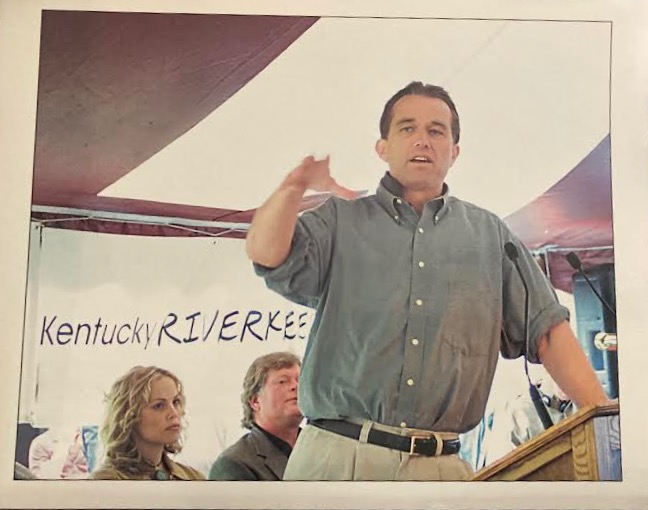
Twenty years later, Kennedy’s Waterkeeper Alliance had established more than 350 similar groups that protected 2.8 million miles of waterways in 48 countries. One of them was Kentucky Riverkeeper, which was launched in 2002 at Fort Boonesborough State Park, where I met Kennedy a second time.
I heard him speak a third time, at the University of Kentucky in 2009, but didn’t try to interview him.
I read his book Crimes Against Nature in 2004, and in 2011, I went to the Kentucky Theatre for the local premier of The Last Mountain, a documentary about the scourge of mountaintop removal mining and Bobby’s clash with Don Blankenship of Massey Energy and Alpha Natural Resources.
I thought Kennedy was a worthy heir of his father, who had been troubled by strip mining and coalfield poverty in the 1960s and was devoted to battling corruption and entrenched special interests.
But along the way, I lost respect for Bobby Jr. as his attention took a bizarre turn from environmental crusades to other causes, including spreading misinformation about childhood vaccines causing autism and the SARS-CoV‑2 vaccines being more dangerous than the coronavirus.
Viral myths
In his 2017 book, American Values: Lessons I Learned from My Family, there wasn’t any indication that Kennedy had become an anti-vaxxer. But in 2021’s The Real Anthony Fauci, Kennedy defamed the prominent infectious disease doctor, lifelong public servant and hero of the coronavirus pandemic with a conspiracy theory about Fauci and billionaire philanthropist Bill Gates profiting from the AIDS and COVID crises.
When others pushed back against his wild accusations, Kennedy accused them of authoritarianism and censorship.
Ironically, he has now teamed up with Trump, an authoritarian who has said he wants to muzzle the press, get rid of professional civil servants and replace them with political hacks who are loyal to him.
Why would Kennedy side with Trump, whom his sister Kerry recently described as the “polar opposite” of the Kennedys’ American values?
Bobby has said it wasn’t revenge, although the Democratic Party did try to keep him off the ballot when he was running in its primaries and the Biden administration denied him Secret Service protection early in his campaign.
What’s more likely is that he knew there was no way he could win the White House, and he decided instead to seek an appointment.
Kennedy revealed days ago that he had been offered a role in Trump’s administration if he’s elected.
According to The Independent, a British newspaper with a global online audience, Trump has agreed to have Kennedy, who is not a scientist, chair a commission on “vaccine safety and scientific integrity.”

Kennedy’s running mate, Nicole Shanahan, who had revealed that he was thinking about getting out of the race and supporting Trump, hinted that he might be aiming higher than a commission. He would do “an incredible job” as secretary of health and human services, she suggested.
Never miss a thing with our FREE weekly newsletter.
Kennedy, who has not publicly said whether he wants the cabinet job, would be an odd choice for HHS. According to NBC News, it has a $1.5 trillion budget and oversees 13 agencies, including some Kennedy has said he would like to overhaul: the Food and Drug Administration, the Centers for Disease Control, and the National Institutes of Health.
NBC reported that, in November, when Kennedy accepted an award from Children’s Health Defense, the anti-vax group he chaired until he took a leave to run for president, Kennedy said he would stop the NIH from studying infectious diseases such as the coronavirus and measles and instead shift to studying chronic illnesses, such as diabetes and obesity.
“We’re going to give infectious disease a break for about eight years,” he said.
That would leave us even more unprepared for the next deadly contagion than we were in 2020.
Kennedy’s brothers and sisters are right: Bobby may be brilliant, but he is unwell, and he is dangerous. If he helps Trump get elected and is allowed to direct public health policy, the “sad ending” they spoke of could well be our own.
