
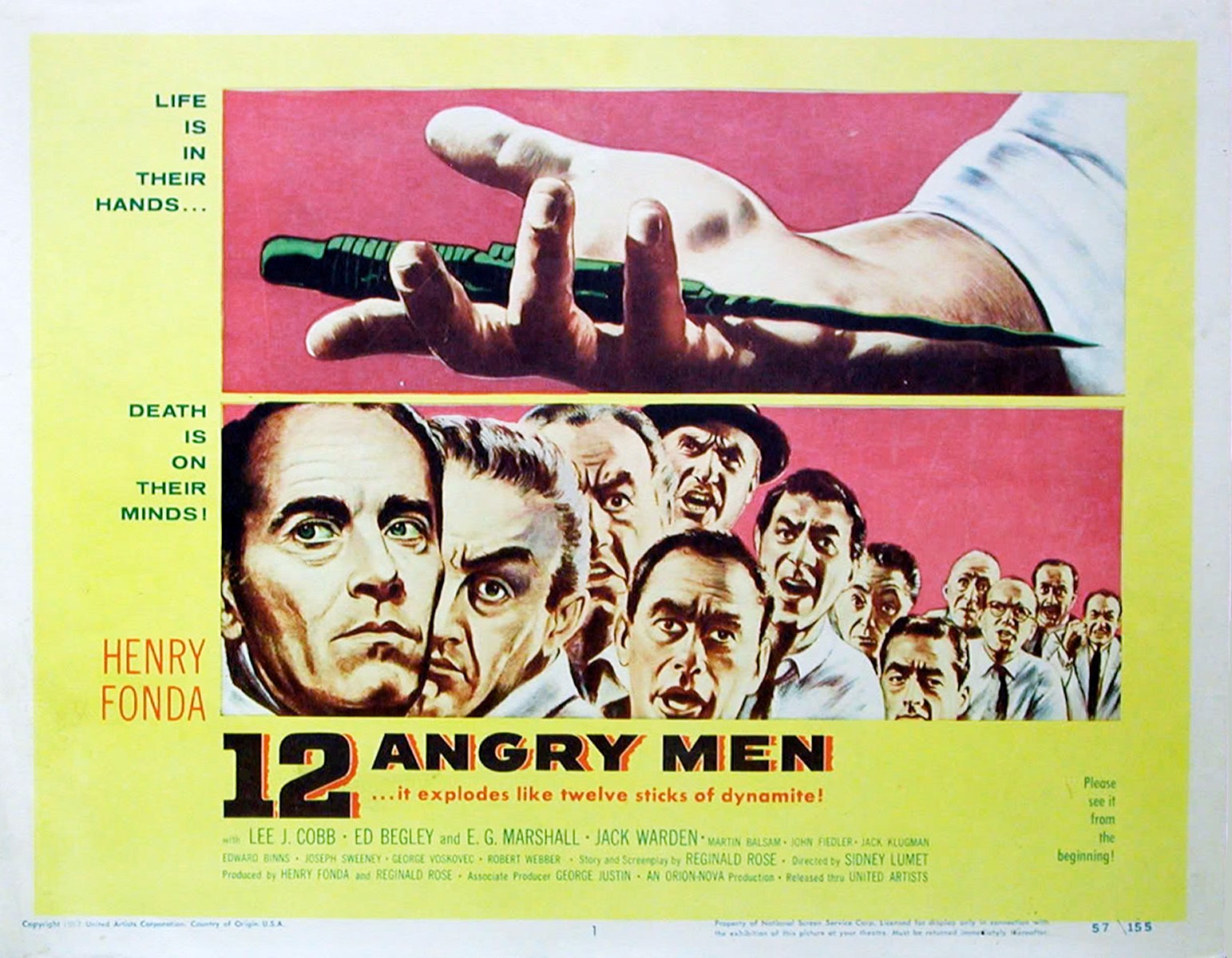
12 Angry Men opens with the trial of a young man accused of murdering his father coming to an end. We witness the judge turning the process over to the jury to determine the young man’s fate. If found innocent, he will walk out of the courtroom a free man. If found guilty, he will face the mandatory sentence of death. His fate is now in the hands of what we will learn are 12 angry men.
The evidence initially points to an easy decision—an open and shut case. There are witnesses, there is the murder weapon, and there is a history of temper outbursts between son and father. The jurors are gathered in the sweltering heat of the jury room, most expecting a quick decision and an early exit. One is anxiously anticipating the Yankees baseball game that evening, displaying the tickets from his pocket. However, the outcome of the initial vote is a surprise to the jurors. Eleven vote guilty, but one votes not guilty. It is at this point that we begin to see the anger rise in the jurors.
Henry Fonda plays the role of the lone juror voting not guilty. He tells them he is not convinced of the young man’s guilt, though he admits the evidence on the surface is overwhelming. But he points out that the fate of this young man, be it life or death, is in their hands and he feels they should discuss the case.
As the discussion proceeds, we begin to get a more in-depth look at the personalities of the individual jurors—referred to primarily by their number. Henry Fonda is Juror #8. We identify the various jurors by their reported vocations, such as “the high school football coach,” “the stockbroker” and “the garage owner.” As discussion and debate continues, we see the prejudices and preconceived notions of the jurors related both to the accused (a teen from a poverty-stricken neighborhood) and to each other. As more detail is examined from the evidence presented, others in the room begin to have “reasonable doubt.”
12 Angry Men was released in 1957 and was adapted from a teleplay aired in 1954 written by Reginald Rose. He also adapted the screenplay for the film. Sidney Lumet was the director, and this was his initial effort at directing a feature film. The television script was largely unchanged in the adaptation for the film. Henry Fonda was asked to portray Juror #8 by the studio, United Artists, and he also served as producer of the film. The cast of jurors was composed of many well-known actors, including Martin Balsam, Ed Begley, Lee J. Cobb, E. G. Marshall, Jack Klugman, and Jack Warden.

All but three minutes of the film was shot in the confines of the jury room. The set was made to appear and feel confining. This was thought to add to the sense of pressure felt by the jurors in reaching consensus. Reportedly the writer, Reginald Rose, was inspired by his own experience serving as a juror on a manslaughter case.
12 Angry Men received praise from critics and was nominated for three Academy Awards, including Best Picture, Best Director and Best Screenplay. The critic for The New York Times wrote “It makes for taut, absorbing, and compelling drama that reaches far beyond the close confines of its jury room setting.” He wrote of the twelve jurors, “their dramas are powerful and provocative enough to keep a viewer spellbound.” Variety found it “an absorbing drama” and stated of the acting performances “perhaps the best seen recently in any single film.” The Los Angeles Times reported it to be a “tour de force in movie making.” The critic for The New Yorker described it as “a fairly substantial addition to the celluloid landscape.” 12 Angry Men even got a spread in the very popular magazine Life.
Unfortunately for the makers of the film, it was a disappointment at the box office. Some think that the rise in popularity of color and widescreen productions may have impacted the commercial appeal. This was Henry Fonda’s initial effort at producing a film, and his experience and frustration contributed to his decision not to produce any other films. It was reported that he was upset with United Artists and their distribution efforts. He felt it should play smaller theaters but instead went into larger settings, failing to fill the theaters. Though the film, when released in 1957, was critically acclaimed, it is believed that the appearance on television in later years brought a new fan interest to it.
In many ways the themes in the film ring very true today. Prejudice and assumptions about people based on their ethnicity, income level, living situations, and so forth ring as true today. I’ll share with you a couple of quotes from the film.

Juror #10: “Bright? He’s a common ignorant slob. He don’t even speak good English!”
Juror #11: “Doesn’t even speak good English.”
And another telling quote:
Juror #10: “I don’t understand you people! I mean all these picky little points you keep bringing up. They don’t mean nothin’. You saw this kid just like I did. You’re not gonna tell me you believe that phony story about losing the knife, and that business about being at the movies. Look, you know how these people lie! It’s born in them! I mean what the heck?! I don’t even have to tell you. They don’t know what the truth is! And, lemme tell you, they don’t need any real big reason to kill someone, either! No sir!”
Juror #8: “It’s very hard to keep personal prejudice out of a thing like this. And no matter where you run into it, prejudice obscures truth. Well, I don’t think any real damage has been done here. Because I don’t really know what the truth is. No one ever will, I suppose. Nine of us now seem to feel that the defendant is innocent, but we’re just gambling on probabilities. We may be wrong. We may be trying to return a guilty man to the community. No one can really know. But we have a reasonable doubt, and this is a safeguard which has enormous value to our system. No jury can declare a man guilty unless it’s sure. We nine can’t understand how you three are still so sure. Maybe you can tell us.”
12 Angry Men was identified by Henry Fonda as one of his three best movies, even though it did not do well at the box office. His other two favorites were The Grapes of Wrath (1940)and The Ox-Bow Incident (1943). I think that if you are familiar with these films, you will see a common bond between the three.
Interestingly, this film is utilized in training by various business schools and workshops to point out team dynamics and conflict resolution methods. Prior to the original release to theaters a preview of the film was provided to the State Bar Associations. After it’s release, the American Bar Association honored the film for “contributing to greater public understanding and appreciation of the American system of justice.” In 2010, speaking at the Fordham University Law School film festival, Supreme Court Justice Sonia Sotomayor stated that seeing the film while she was in college influenced her decision to go into law as a career. She stated that she was very inspired by the statement of Juror # 11 (an immigrant) regarding his appreciation for the American system of justice.

As mentioned above, 12 Angry Men first appeared on television, the CBS program Studio One. It was broadcast in September 1954 and starred Robert Cummings as Juror #8. The theme from the film has found its way onto several other TV shows. An episode of The Andy Griffith Show in 1960 found Aunt Bee as the lone juror voting “not guilty” and facing the wrath of 11 angry men. Sheriff Andy Taylor discovers the real criminal, and the accused (Jack Nicholson) is kept from being wrongly found guilty. Another show was The Dick Van Dyke Show where Rob Petrie was the lone holdout in the jury deliberating on the fate of an exotic dancer (Sue Ann Langdon) on trial for diamond smuggling. That episode also took a funny stab at another popular TV show, Perry Mason. Here the prosecutor was named Mason, and the defense attorney was named Burger.
Never miss a thing with our FREE weekly newsletter.
Roger Ebert has listed 12 Angry Men as one of his “Great Movies.” American Film Institute lists Juror #8 (Henry Fonda) on a list of the “50 Greatest Movie Heroes of the 20th Century,” and the film on its list of Best Films of the Last 100 Years. American Film Institute also lists it as #2 in its Top Ten List of courtroom dramas (To Kill a Mockingbird is #1).
I believe 12 Angry Men is as relevant in today’s society where we still battle with prejudices, stereotypes and biases based on race, income, sexual identity and ethnicity to name a few. I believe we could benefit from more discussion and less ranting, and this film brings that concept to light. If you are not familiar with it, I encourage you to check it out. And, if you have seen it before, I think you may find it will be a good one to return to once more.
The Internet Movie Database (IMDb) rates 12 Angry Men at 9 of 10. Rotten Tomatoes gives it a critics score of 100% and an audience score of 97%.
I searched my Roku for free streaming and found the film available on Kanopy (no ads), Tubi, Pluto and ROKU Channel. The Clark County Public Library has a copy of the DVD on the shelf.
If you enjoy these older films, please join me for “Ron Kibbey’s Comedy Classics” at the Clark County Public Library. On the second Tuesday of each month at 6 pm, I show a classic comedy film (such as Laurel & Hardy, Charlie Chaplin, Marx Brothers, and Abbott & Costello, to name a few). Usually there is an accompanying classic cartoon, and the library provides popcorn and drinks. More information about the next film is available on the library’s website and Facebook page.
Until the next Reel Classic, enjoy the trailer below.
