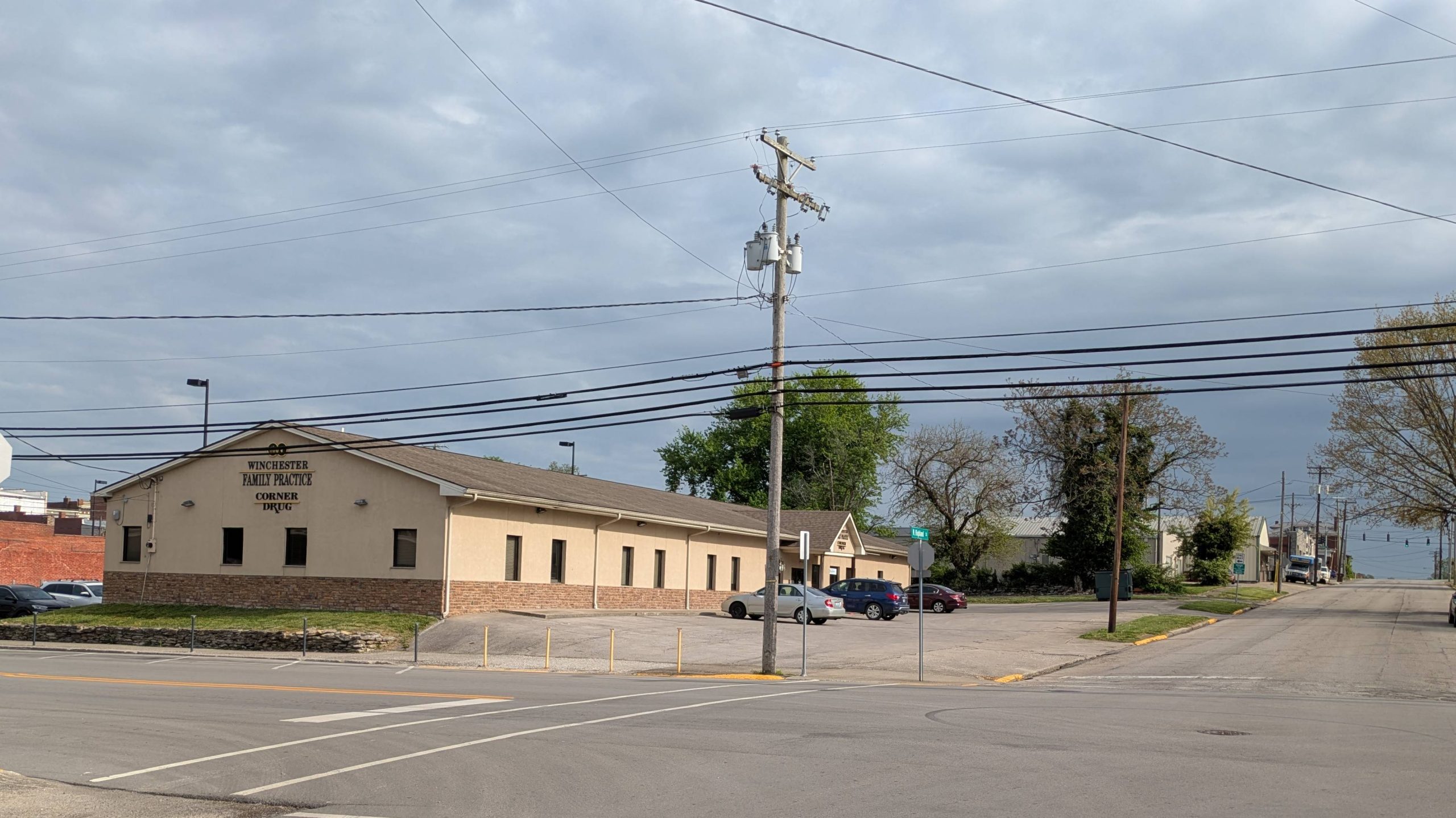
Ann Smith’s name appears in the 1810 census for Winchester. She was over 45 years old and head of a household that included one white male aged 10 to 16 and one enslaved person. She owned three city lots—46, 47, and 48—on the west side of Highland Street, beginning at Main Cross (Broadway) and running north to the middle of the block. In 1809 the Clark County Court awarded her a license to retail liquor and operate a tavern. Her tavern stood on one of these lots. She acquired all her property under the name “Ann Sphar”—and thereby hangs a tale.
The story begins with the patriarch John Ulrich Sphar, who brought his family from Germany and settled in what is now Berkeley County, West Virginia. His sons Jacob and Matthias Sphar were among the first residents of Strode’s Station in the fall of 1779. Their brother Theodorous soon joined them with his wife Ann and their children.

In March 1781 Indians attacked Strode’s Station, where Jacob Sphar was shot and scalped. In September 1784 Matthias Sphar was killed by Indians in what is now Bourbon County. Sometime after these tragedies, Theodorous returned to Berkeley County. His wife Ann stayed behind. According to a Sphar family history, she “ran off with a man named Jacob Smith, Winchester, Kentucky. Theodorous traded 200 acres of land for a horse and returned to Virginia.”
We can verify that Ann remained in Winchester and began using the names Sphar and Smith interchangeably. In March 1803 the Clark Court paid Ann Smith $4 for “two days & one Night sitting by William Stewart” at her tavern and providing him with “whisky & Candles.” Stewart died while in her care. The coroner’s inquest, held “in the house of Anna Sphar,” found he died of natural causes. No record of a divorce from Theodorous Sphar or marriage to Jacob Smith has been found.
In The Proud Land, Goff Bedford states that “Ann Smith and her sister Mary had a rather long record for bootlegging and the oldest profession. It was a tolerant community.” While this may be true, I have so far been unable to verify these claims.
When Ann Sphar wrote her will in September 1814, she was living in a house at the corner of Main and Broadway that she had purchased from her son‑in‑law, John Gosney. Her son, “William Sphar alias William Smith,” served as executor of her will, which was probated in January 1815. She named her children by Theodorous—John, Nancy, Catherine, Betsy—and a granddaughter, Marthy, the child of her deceased daughter Rebecca. She also named sons Jacob and William, her children by Jacob Smith.
Never miss a thing with our FREE weekly newsletter.
Her children with Theodorous must have remained in Clark County or returned after their father went back to Berkeley County. All were living in Clark County when they sold their mother’s property. Since she signed all her official documents—deeds and will—as Ann Sphar, it seems unlikely she and Jacob Smith ever married.
Jacob Smith, listed as a Winchester resident in 1810, was in Clark County by 1793 and possibly earlier. He owned more than six hundred acres of land east of Winchester. In 1795, he was licensed to keep an ordinary (tavern).
Jacob died in 1838 and left a detailed will. He wrote, “I Desire all my slaves shall be Freed amediately after my Death & all costs of their emansopation shall be paid out of my estate.” Seven enslaved people were named, and three received additional generous bequests. To “David my Faithful slave,” he left “one Horse worth Fifty Dollars, two milch cows, one Sow and pigs, a how plough & axe & his beding & Household Furnature.” The remainder of his estate he left to “my Two Sons whom I dearly Love, Jacob who is commonly Called Jacob Spaw & William who is generally cald William Smith.”
The wills of Ann and Jacob confirm that they had two children together, Jacob Jr. and William. From the limited evidence available, Jacob Sr. appears to have been a decent man. No doubt much of this story remains untold.