
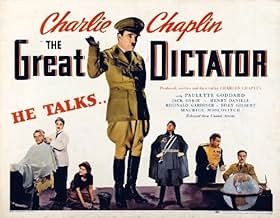
In the year 1938, Charlie Chaplin, one of the most famous comedians of the time, began writing a script based on one of the most infamous Fascists of the time — Adolf Hitler. The goal was to make a political satire and comedy that would be a parody of Hitler, the Führer of Nazi Germany. The character he portrayed was Adenoid Hynkel, the Phooey of Tomainia. This classic Chaplin film is today’s Reel Classic—The Great Dictator.
In 1938 Hitler was engaged in expanding his rule in Europe. At that time, the United States was not involved in the war and still had relations with Nazi Germany. The vast majority of American citizens then were opposed to U.S. involvement in the war in Europe. Chaplin realized that making this film could be very controversial. Hollywood studios were hesitant to take on the project, and Chaplin financed the endeavor himself. In fact, he also wrote, produced and starred in the film and was involved in the musical score.
Chaplin actually plays two roles in the film. In addition to Adenoid Hynkel, he also plays a working class Jewish barber living and working in a Jewish ghetto. The barber is a veteran of the first World War who spent time in a hospital with injuries after having saved the life of a pilot, Commander Schultz (Reginald Gardiner). Twenty years later, the barber stills suffers from amnesia, and Schultz is now an officer in the military that oversees the ghetto.
The barber falls in love with a neighbor woman, Hannah, (Paulette Goddard) and together they work in the resistance movement within the ghetto. Storm Troopers arrive and capture the barber and are about to execute him when Commander Schultz recognizes him as the soldier who saved his life 20 years ago. Schulz prevents the execution, and their conversation about the past helps to restore the memory of the barber.
Meanwhile, The Phooey is trying to persuade a Jewish banker to loan money to help finance the growing military forces of Tomainia. When the banker refuses, Hynkel orders a purging of the Jews and has them sent to concentration camps. Commander Schulz protests this action and is arrested and is also sent to a camp. He escapes the camp and goes to the ghetto, where he hides with the barber. Eventually he and the barber are discovered by the troops and are sent to the concentration camp. Hannah and her family flee the country to the neighboring Osterlich.
Meanwhile, Hynkel meets with fellow fascist dictator Benzino Napoloni (Jack Oakie). He is the Diggaditchie of the country Bacteria (a take on Mussolini of Italy). They are trying to decide which country will invade the neighboring country of Osterlich. It is finally agreed upon that troops from Tomainia will invade Osterlich, and in doing so, Hannah and her family are captured.

Back at the concentration camp, Schulz and the barber manage to steal some military uniforms and escape the camp. Given his remarkable resemblance to Hynkel, the barber in uniform passes as the Phooey. Meanwhile, a victory parade is planned in Osterlich, and Hynkel is to speak. Prior to his appearance, Hynkel decides to dress in regular clothes and goes out into the woods to duck hunt. He is mistaken by troops for the escaped barber and arrested. Schulz and the barber arrive in Osterlich and witness the victory parade. The barber, still in uniform, is mistaken for Hynkel and asked to speak to the crowd. He provides a very stirring and passionate speech, but not exactly what the crowd was anticipating. Hannah hears his voice on the radio and listens. His last few lines of his speech are addressed specifically to her. He says: “Look up, Hannah. The soul of man has been given wings, and at last he is beginning to fly. He is flying into the rainbow, into the light of hope, into the future, the glorious future that belongs to you, to me, and to all of us.” And, she has hope.
The Great Dictator marked a couple of important milestones for Chaplin. Released in 1940, it was 11 years after the end of the “silent era.” However, this was Chaplin’s first film with all talking and sound. Though he had made Modern Times earlier and it did have some sounds, it was still primarily a “silent” film. This film also marked the last appearance of the “Little Tramp” character, though Chaplin denied that the barber was the “Little Tramp.” But he had the characteristic mustache, bowler hat, and cane of the infamous character.
Paulette Goddard, who played Hannah, and Chaplin appeared together in the film Modern Times. They had married in 1936 and remained married until 1942. During the filming of The Great Dictator, their relationship began to fail, though reportedly they both worked to maintain it. Their divorce and parting were amicable.
As mentioned above, there was concern about the making and releasing of this film. The British government, when learning of the pending making and release of the film, stated it would be banned in Britain, because at that time, the government was trying to appease the German Nazis. However, by the time it was released in 1940, Britain was at war with Germany, and the film was welcomed. Several Latin American countries with pro-Nazi leanings also banned the film. When President Roosevelt learned that the Hollywood studios were trying to discourage the making of the film, he sent a representative to meet with Chaplin and encourage him to go forward with the project. Upon the film’s release, Chaplin and his studio received many threatening letters from American Nazi sympathizers. Needless to say, Hitler banned the film in Germany and all of the countries they had occupied. Spain’s dictator Francisco Franco banned the film in his country, and it remained banned until after his death in 1975.

The Great Dictator turned out to be the most successful box office hit of Chaplin’s career. It was also well received by film critics. It was nominated for five Academy Awards, including Outstanding Production, Best Actor (Chaplin), Best Supporting Actor (Oakie), Best Writing (Chaplin), and Best Music. The critic for The New York Times described it as “a truly superb accomplishment by a truly great artist ... perhaps the most significant film ever produced.” The critic for The New York Herald Tribune wrote, “The Great Dictator is a frank, hard-hitting attack on Fascism, in which violent caricature bulks even larger than the immutable comedy of human existence that Chaplin knows so well.” Roger Ebert gave the film four of four stars and included it in his list of Great Movies.
More recent reviews have also been very positive. The Rotten Tomatoes Critics Consensus reads: “Charlie Chaplin demonstrates that his comedic voice is undiminished by dialogue in this rousing satire of tyranny, which may be more distinguished by its uplifting humanism than its gags.” In October 2025 NPR did a story on the film and focused on the speech given by the barber posing as the Fascist leader Hynkel. Excerpts from that powerful speech include:
“I’m sorry, but I don’t want to be an emperor,” he gently informs an assembly of Hynkel’s army and advisors. “I don’t want to rule or conquer anyone. I should like to help everyone if possible. Jew, gentile, Black man, white. We all want to help one another. Human beings are like that. We want to live by each other’s happiness, not by each other’s misery.”
“Greed has poisoned men’s souls,” he continues,” has barricaded the world with hate, has goose-stepped us into misery and bloodshed. We have developed speed, but we have shut ourselves in.”
The NPR story also pointed out how some took Chaplin’s words to be a promotion of Communism. FBI Director J. Edgar Hoover compiled a folder of over 1900 pages on Chaplin and Senator Joe McCarthy accused Chaplin of being a Communist sympathizer. Ed Sullivan, later known for his long-running television show, was a newspaper columnist at the time of the release of The Great Dictator. He, along with another popular gossip columnist, Hedda Hopper, attacked Chaplin and the film as being pro-Communist. These efforts later led to Chaplin being exiled from this country.
The story from NPR ended with the following line: “But 85 years after it debuted, his movie stands as a testament to how art can stand up to tyranny and how hard it can fight.” In a BBC article reviewing the picture from a few years ago, a very telling description was written: “What’s even more remarkable is that Chaplin didn’t just capture Hitler, but every dictator who has followed in his goose steps …. If you want to see a crystalline reflection of the 21st century’s despots, you’ll find it in a film that came out 80 years ago.”
Never miss a thing with our FREE weekly newsletter.

In 1997 the Library of Congress selected The Great Dictator for preservation in the National Film Registry. In 2000 the American Film Institute identified it at # 37 in the Top 100 Funniest American Movies. The Internet Movie Database rates the film at 8.4 of 10. Rotten Tomatoes gives it a Critics Score of 92% and an Audience Score of 95%.
In searching my Roku device, I found several sites offering the film for screening including Plex, Shout TV, Pluto TV, Classic Comedy Channel and Kanopy (available free with your library card). Unfortunately, there is not a copy of the DVD at the Clark County Public Library, but they will obtain a copy if you ask.
Along with the movie trailer, I am also including the final speech discussed above. It is only several minutes long, but is a very powerful statement. Please take a few minutes and watch it. The words are as relevant today as they were in 1940.
Information for this Reel Classic review was gathered from Internet Movie Data Base (IMDb), Rotten Tomatoes, Turner Classic Movies (TCM) and Wikipedia.
Ron Kibbey’s Comedy Classics
If you enjoy these classic movies, please join Ron on the second Tuesday of each month at 6 PM at the Clark County Public Library for “Ron Kibbey’s Comedy Classics.” The evening features a classic comedy film, usually accompanied by a vintage cartoon. Popcorn and drinks are provided. More information about the next film is available on the library’s website and Facebook page, as well as WinCity Voices Facebook page.
